Coolcation in Helsinki: A Summer Escape When the Rest of Europe Bakes

There is a pattern we notice every July. The search numbers for Helsinki spike at the same time the temperature maps of Southern Europe go orange.
People are done with the heat. They want somewhere that still feels like summer, without the 38-degree pavements and the full hotel air conditioning running overnight.
Helsinki is that place. We live here, and the summers are genuinely comfortable in a way that the rest of Northern Europe does not always get credit for.
What follows is the honest version, the good and the not-so-good, so you can decide whether the timing fits your trip.
What a Helsinki summer actually feels like
June, July, and August are reliably mild. The Baltic Sea moderates the heat, and a light sea breeze off the water is the normal state of a Helsinki summer afternoon.
Typical summer days are warm, not hot. Shorts and a t-shirt work fine in the afternoon.
But the day is not the evening. Pack for both, because a warm afternoon often turns into an evening that wants long trousers and a sweater.
A fun benchmark: Finland’s official heatwave threshold is 25 degrees Celsius. That sounds absurd from anywhere near the Mediterranean, but at 25 degrees a Finn is already fanning themselves and muttering about the heat.
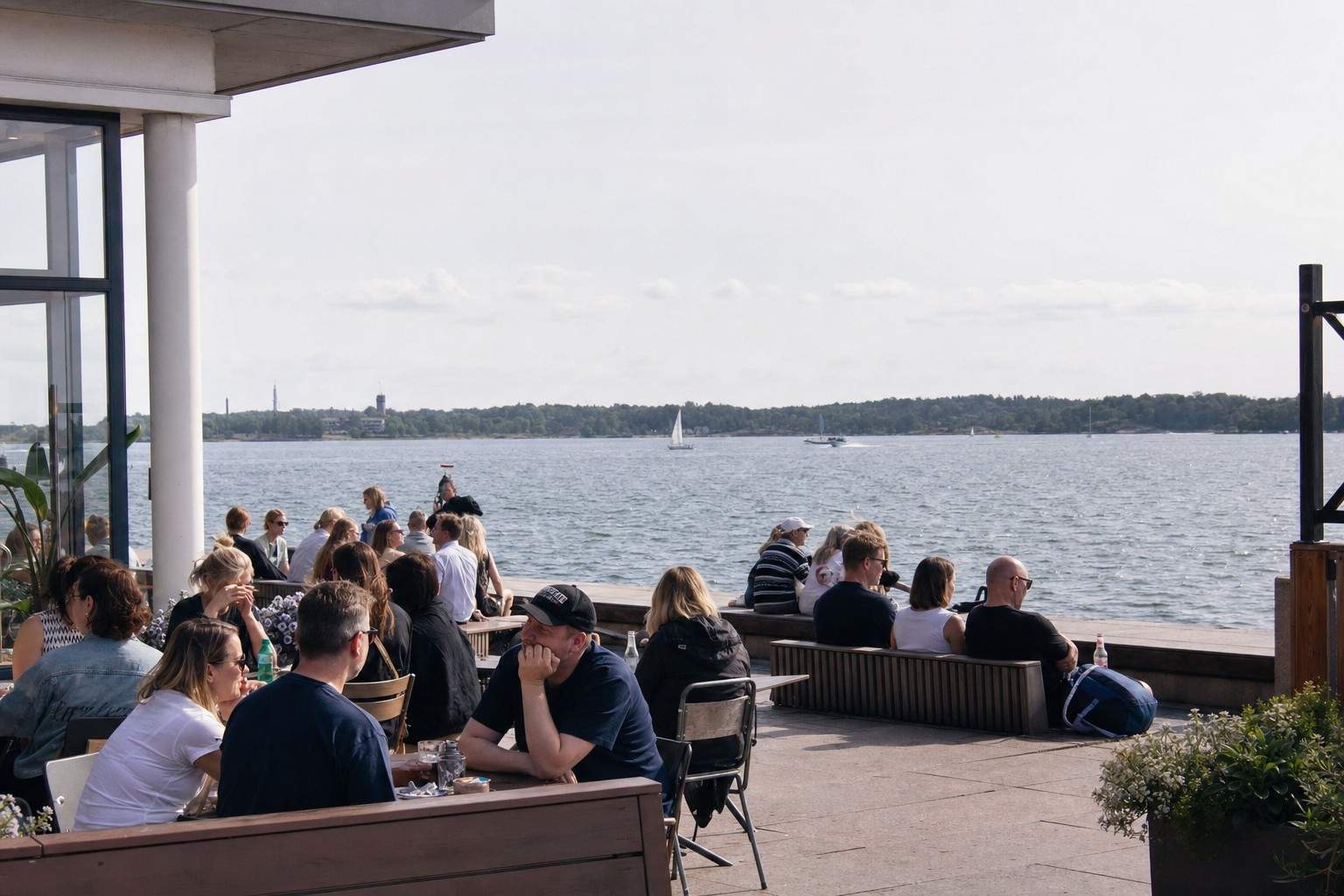
The city opens up completely. Terraces fill. People swim in the sea. Saunas run all day along the waterfront.
One thing to say plainly: Helsinki is not a guaranteed cool paradise.
A real heatwave does hit, usually once a summer. When it does, the city turns genuinely hot and humid, and Helsinki is not built for it.
Most warm evenings still cool down fast, which is the relief a southern European city cannot give you. But in a true heatwave even that fails, and the heat hangs on into the night.
Many apartments and rooms have no air conditioning. Usually that is a non-issue. In a heatwave it is not, so check before you book an apartment-style stay.
And nothing about the weather is fixed. One summer brings four days of rain that does not stop, the next brings ten dry days of heat in a row. Pack a light jacket and loose plans.
Most warm evenings still cool down fast, which is the relief a southern European city cannot give you.
The daylight is the main event
If you have not experienced a Finnish summer before, the light is the thing to prepare for most.
Around midsummer, the sun barely dips below the horizon. What follows is not darkness. It is a long blue twilight that fades and then rebuilds without ever fully going black.
We think of it as the sky forgetting to switch off.
This changes how the city moves. Dinners stretch late. People are on terrace seats at ten in the evening because it still looks like late afternoon.
A walk along the waterfront at eleven at night, harbour pale and sea quiet, is what most first-time summer visitors remember.
Plan loosely. Your one day in Helsinki runs longer than a day in winter without any effort at all.
What to do in a Helsinki summer
The summer version of Helsinki is different enough from the winter version to plan around. There are specific things that are only good in these months.
Suomenlinna by sea. The public ferry from the Market Square runs on the day ticket and takes about fifteen minutes. The sea fortress has café terraces open on the water and a wind that keeps the warmth honest.
We cover the full visit in our one-day Helsinki itinerary, which shows you how to fit it into a single day without rushing.
Sea swimming and the public saunas. Löyly and Allas Sea Pool are both on the waterfront, both open in summer, and both have sea swimming alongside the sauna.
These are not tourist experiences dressed up for visitors. Locals fill them on weekday evenings.
Book ahead, especially Löyly, where a same-day slot in July is a real gamble. Allas is the better bet if you are chancing it on the day.
The archipelago. Helsinki sits at the edge of the Finnish archipelago, and summer is the only time the island network is fully open. Day trips to smaller islands beyond Suomenlinna are possible on scheduled ferries.
We have the wider picture in our guide to Helsinki itineraries.
Terraces and parks. The Esplanadi fills with locals on any afternoon that looks half-decent. The harbour terraces get busy, but walk two streets back and you find a restaurant where the same meal costs noticeably less.
The Market Square in the morning. The coffee tents on the South Harbour are a real local stop, not a tourist trap. Order a korvapuusti and a coffee early, before the cruise ships add to the foot traffic.
Is Helsinki actually cooler than where you are going?
The “coolcation” framing is real, but it needs a calibrated answer.
Helsinki is reliably cooler than the Mediterranean coast in July and August. It is also cooler than most of Central Europe during a heatwave.
For anyone coming from Spain, Italy, Greece, or the south of France in high summer, the difference is noticeable from the moment you step outside.
The comparison gets closer if you are from the UK, the Netherlands, or Scandinavia. Those places also have mild summers in most years.
Helsinki’s advantage there is the light and the sea access, not a dramatic temperature gap.
If you want the month-by-month numbers, our seasonal guide to Helsinki lays the temperatures out. The short version is that summers are mild and vary a lot from year to year, so a single average hides the range.
What does not vary much is the feeling of the city. Calm, open, bright, and manageable. The pace is slower than the Mediterranean high season. The locals are genuinely out and in good spirits, which is its own kind of weather.
When to come
June, July, and August are all good. Each has a character.
June is the midsummer peak. The light is longest in late June around Midsummer (Juhannus), and many Finns leave for summer cottages over that long weekend.
The city can be unusually quiet over Midsummer itself.
Some restaurants and businesses close. If you want the very longest daylight, come in mid-to-late June, but check what is open before you plan around specific places.
July is the most reliably good month. Most businesses are open, terraces are running, and the light is still very long. Helsinki does not feel overrun the way some European capitals do in July.
August suits you if you prefer calmer crowds. The light shortens noticeably through the month, but evenings are still long by most standards. Sea swimming stays warm enough into early August most years.
The seasonal picture across the whole year, including when to avoid, is in our when-to-go guide for Helsinki.
The honest summary
Helsinki in summer is comfortable, bright, and less crowded than the European alternatives people are fleeing.
It is not tropical. It is not guaranteed to be cooler than your living room on a specific day. But it is reliably mild. The daylight is extraordinary. The sea is close, and the city runs at a pace that feels like a genuine rest.
If your reason for coming is to escape summer heat, Helsinki will almost certainly deliver.
Just pack the light jacket, book Löyly in advance, and plan your first evening to end late with the sky still glowing. That is the summer we would give a friend.